
Scripting for Game Trailers Part 2: Music
There’s a common misconception that music can be slapped onto a trailer when it’s nearly complete, and the audio will just 🪄work✨ and make everything better.While I have worked on trailers where the final music comes in towards the end of the project, this is never the ideal situation. Music is rhythm, pacing, tone. Music tells you how intense a scene is and emphasizes the emotional impact. Music can tell you where the sudden cut to black should be, before we reveal the name of the game.Music is the beginning of the scripting process. 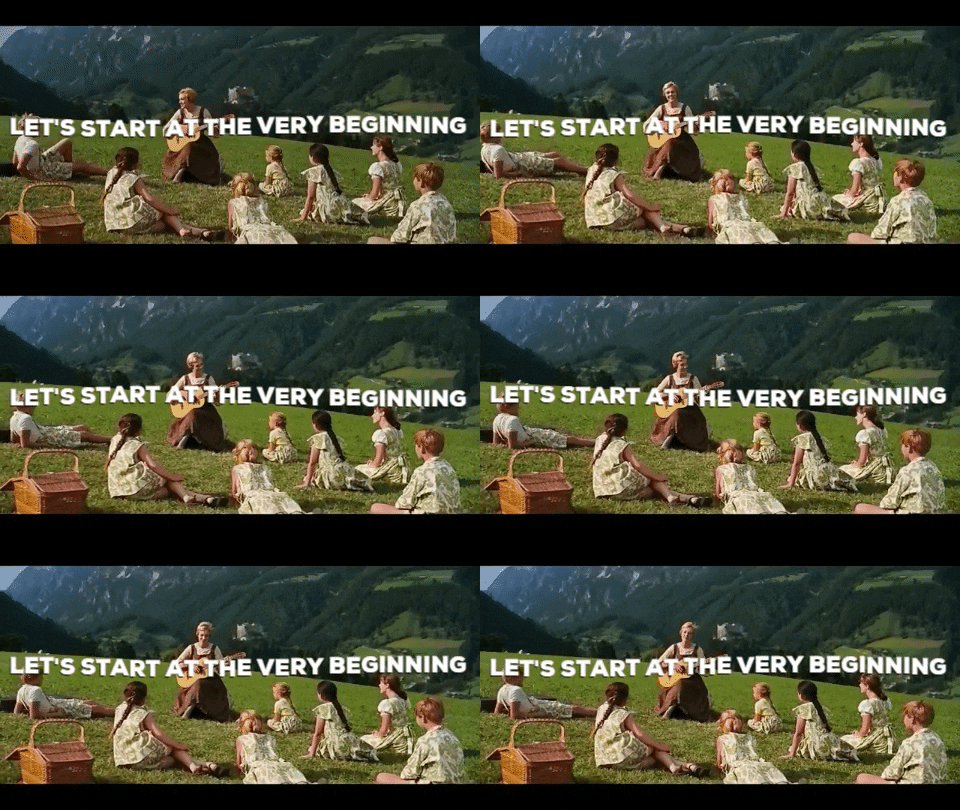
One of the first things I ask for, at the start of the trailer creation process, is the available soundtrack for the game. It may not be complete and the tracks may still be WIP, but I like to listen to everything that’s been composed so far. This is for two reasons: First, the music will help me get my head in the game (so to speak), and understand the tone and key emotions for the project. Second, I want to think about which available track would be the best option for use in the trailer.I’ll often narrow it down to a few options. As I listen to those tracks, a third, fourth, fifth time, I’m paying attention to what’s happening in the music and thinking how I can use it in the trailer. I’m looking for things like:Levels: Does the track have both slow, quieter moment, as well as ramp-ups in intensity? Can I use the existing structure of the music to show an increase in drama over the course of the trailer?Pace: Is the music slow and similar throughout? Or does it get my feet tapping and my head bopping?Emotion: Does the major emotion of the track match what we want to convey in this particular trailer? For example, it might be a beautiful track but it won’t make sense out of context, since you only hear it during a late-game story moment we don’t want to spoil.Drop: Is there a “beat drop” or “record scratch” moment, where the tone of the music suddenly changes? This is very useful for end slate reveals.
Let’s say there are two possible tracks that I think could work well in a trailer. They’re both bops that will keep interest, they both have varying levels of intensity, maybe one is a little slower in pace but I think that could work for the project. To help me decide which music option I recommend using, I will often create a Video Outline.A Video Outline is a broad outline of the planned content for the trailer, timed out with the music. Derek Lieu has an excellent blog post about video outlines, so I won’t go too into the weeds about about them here, but I do recommend you check out his post if you want to learn more.The first thing I do when making a video outline is create a custom cut of the music. If a trailer is planned for inclusion in a press showcase, you may have a strict runtime limit of 30 / 60 / 90 seconds. Even if you have more flexibility, you’ll know a rough runtime you’re aiming for, whether it’s teaser-length (~30 seconds), a standard length (60-90 seconds), or a longer-form trailer (2+ minutes).So I would take the two music options and chuck them each into the Adobe Premiere timeline. Then listen through them and find places I can cut up the track. If a section of the music lasts 4 bars, can I I cut out 2 bars and go straight into the next section? If the first 20 seconds of a track are very quiet, but I think the trailer should begin with a bang, can I remove the introduction in the music? If there’s a great beat drop moment, I’ll want to try to keep that close to the end of my cut, so it can accompany an end slate reveal.
I’ll meddle a bit with each track, and come up with a custom cut as close to the desired runtime as possible. Then it’s time to try to apply some text descriptors for each section of the trailer, and see how well it fits. Is there a good fit for each key message we need to communicate in the trailer, that the music supports?What I might realize as I go through this process is that one music track is a better fit for our trailer. Music with a stronger emotional resonance will support a trailer focused on story. Music with a consistent high energy is a good fit for action-packed gameplay. Music that starts slow and increases in intensity will work well for introducing mystery and/or tension.But what if you don’t have a soundtrack yet? Or, what if your soundtrack is mostly ambient, background music—a good fit for the game itself, but it may not grab attention. And for trailers, we want to be grabbing and holding attention.Whenever possible, I want to use music from the actual game soundtrack. Because that music has been composed for the game itself, it will of course be imbued with the tone, characteristics, and core emotions of the game.When that isn’t an option though, royalty-free music can be a godsend. Whether your preferred audio library is Artlist, Epidemic Sound, Envato Elements, or something else, you can almost always find a track that suits even the most specific needs of a trailer.Take this trailer I made for Scriptorium:When we were looking for royalty-free music for the trailer, the prompt from the publisher "lo-fi medieval music", with an upbeat and jolly feel, and not too ambient. And as you can see in the final trailer, we were able to get pretty close to that initial prompt.A very different tone was needed for Forgotten Mines. The prompt was to find a music option with a dark fantasy vibe, something that would make you think of dwarves delving deep into their mines. You can hear the music we landed on in the final trailer: From these two options alone, it's clear you can find a wide variety of music in audio libraries. The important thing is to always make sure the music still sounds at home in the world of the game. All other elements of the script should be kept in mind, so you’re not creating a tonal clash.Sometimes you’ll be blessed with the help of a game composer from the beginning of a trailer project, and they’re able and willing to create a custom track specific to your scripting needs. This is both a boon and a burden (no shade intended to composers!) simply because you’ll need to do some of the scripting without music, in order to tell the composer the timing and placement of the key emotional beats of the track. And since music is such a helpful element in deciding where things should go in the trailer, this means you begin the project by working backwards a bit.Still, the effort is always worth it! Here’s how I usually tackle this challenge: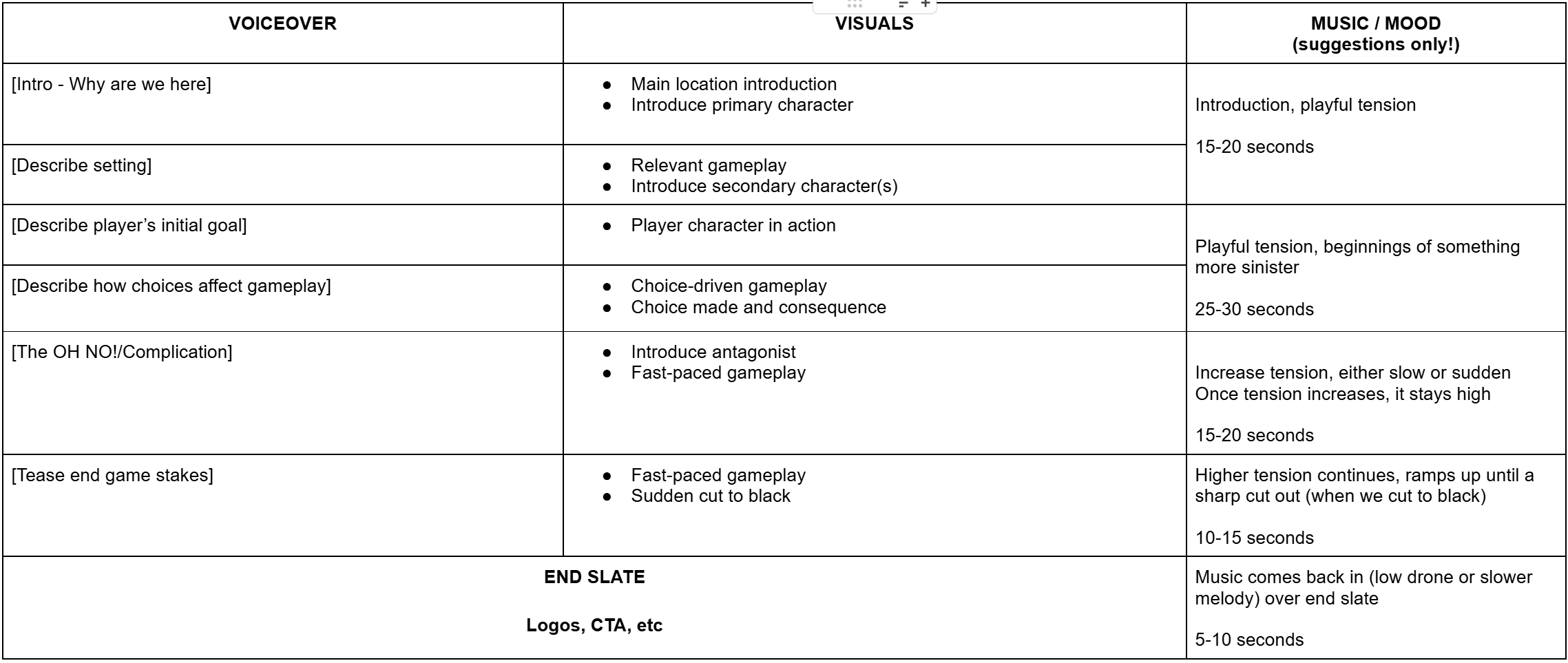
The above is a mocked-up example of what I might share with the composer (edited down from a past project). Accompanying my rough outline of the script, I will add a column with suggestions on timing, tone, and intensity.The example above includes voiceover, which is supremely helpful when trying to time out a trailer without music. The timing suggestions I shared in this example were largely based on the voiceover script, and this allowed me to estimate how long we’d need each section to last. I timed myself saying each line (as slowly as possible to give us wiggle room) and estimated from there.Even when the composer does give you a custom track like this, I would still recommend revisiting the script once you have that music in hand. You may need to tweak the timing and placement of voiceover lines or footage, to make everything fit together just right. , so it's important to make sure everything fits together just right.
Music is the backbone of any trailer script. It sets the pace of the cuts, enhances the tone of the content, and serves as a conduit of emotion. Trying to make a trailer without music is like trying to bake a cake without a cake pan. It’s going to get very messy.Stay tuned for more! Next time we will discuss how TONE affects scripting.
This post is part of a series about how scripting for game trailers is made up of several creative factors that all interconnect and combine. I am releasing these parts a couple days apart, during this week.
This is also by no means every single aspect of scripting for trailers. The key thing to keep in mind is that everything is connected, and because of that it’s important to always keeps your goals in mind as you progress with your scripts.