
You’re hiring your trailer editor too late
“We need this trailer in 2 weeks” is something editors hear all the time, and it always makes us wince. Is it doable? Sure! And we do it all the time, because we like the client or we think the game looks awesome, or we just really want to help out. But a 2 week turnaround for a trailer project is a major crunch and comes with a lot of sacrifices.So let’s break it down. What do editors actually do when we make a trailer, and why does it take so long?ONBOARDING
Getting ready for project kickoff includes a few important steps that can take anywhere from days to weeks to get through.You might reach out to multiple editors to see who has availability, who’s the best fit for your needs, and whose fees are aligned with your budget.Once you make your choice of who to work with, you’ll need to gather assets to give them what they need to begin working. This will include things like a capture-ready build, art assets they can use to create motion graphics, as well as game fonts and company logos.You might do a call to discuss your goals for the trailer and brainstorm collaboratively, or you might need to gather that information into some kind of brief document.You might need to add the editor to your team’s Slack or Discord.You may need to go back and forth on selecting the best music for the trailer, whether selecting a track from the available soundtrack, or choosing a royalty-free option from an audio library.And most importantly, the editor will need to review everything you send them and get familiar enough with the game that they can think creatively about how to best communicate your goals to a viewer audience.The onboarding process can easily be done in a few days, but it can also take weeks if the build isn’t ready, some team members are unavailable, or if internal discussion(s) are needed for everyone to agree on decision.SCRIPTING
I’m using the term “scripting” broadly here, to include everything related to the outlining, storyboarding, and actual writing via title cards and/or voiceover dialogue. Everything we show, and in what order, makes up the script of a trailer.Not all projects require scripting. Sometimes teams have a clear idea of what they want, but that’s honestly pretty rare. It’s normal for a team who have been deep in the gamedev mines to be unsure of how to best communicate their game, in a visual format, to new users, in 60-90 seconds. If they have a marketing person (a consultant for example, or someone on the publisher side), that’s a huge help, but not every team has access to that skillset.Scripting takes time, not just because of the actual wordsmithing, but because the editor is trying to summarize and simplify years’ worth of work. This means it may take multiple rounds of drafts, multiple collaborative calls, and a lot of Slack back-and-forths to nail down a script that feels right and true to the game.
TIME ZONES
Editors are used to working with clients all over the world. This means time zones are a big factor when we’re trying to talk to each other. You may only have a few hours of overlap each day, which means it can take multiple days for a collaborative conversation to happen.Furthermore, many developers are working across multiple time zones within their own team, which adds another wrinkle.Communication tools like Discord and Slack make this much easier, and editors will do their best to be available when their client is online. But even with the best efforts from everyone, time zones can mean that it takes 4 business days for feedback to come back to the editor, instead of 2.FEEDBACK & QUESTIONS
Speaking of feedback, giving feedback to an editor is a skill in itself. I plan to write a post about this eventually as I see a lot of common mistakes made within feedback rounds, such as being too vague or not clearing up different opinions within the dev team.Feedback confusion is normal though, and nothing to be ashamed of. When a good editor sees a note in feedback that they don’t understand, they will follow up quickly with the team to clarify what’s meant, so they know how to proceed efficiently.But because endless reasons such as people going on holiday, needing a brainstorm call, or the aforementioned time zones, that clarification process can add another day (or multiple days) to the feedback round.PEOPLE ARE BUSY
Game devs are usually (get this) busy making the actual game! They’re in meetings, they’re working hard to meet sprint goals, they might even be juggling a day job at the same time.It’s all too common that the trailer project is simply not the highest priority for a dev team. And that’s okay! But it does mean that the editor has to wait extra time to receive assets, get feedback, get an answer to clarifying question, etc. All of which means the project will take more time to complete.
ADDITIONAL WORK: MUSIC, VFX, ETC
I often work with teams who have a composer and/or sound designer in-house or contracted. Assuming that person is available, they might do a music pass and/or a sound pass on the trailer, towards the end of the project. This might mean they are reworking the song used to be even more awesome, or adding SFX, or simply balancing all audio so dialogue isn’t overpowered by the music, etc.That person’s work takes time! It’s so worth it, as good audio can really make the difference for a trailer. You just need to plan ahead and make sure they have enough time to do their thing.SAMPLE SCHEDULES
Okay, we’ve talked about a lot of basic factors that can mean a project takes longer than we think it will. Basically, people are not robots and it can take time for us to collaborate and communicate.So what does that actually look like, in a trailer project schedule?I like to create schedules for clients when we kick off a project, to set expectations on when they’ll be receiving updates from me, and when I would ideally like to get feedback on those updates. Schedules are always working backwards from the final deadline set by the client, and always need to be flexible to support a dev team’s needs (like needing more time to prep a capture build, or needing to wait until someone’s back from leave).Here’s an example schedule based on a 4-week turnaround, assuming a deadline the day before Gamescom and a kickoff at the beginning of August.First Draft: July 31stFeedback requested by August 4th
Second Draft: August 7thFeedback requested by August 11th
Third Draft: August 14thFeedback requested by August 18th
Stems sent to composer for Audio Pass: August 19thFinal audio to be received August 21st
Final Deadline: August 25th
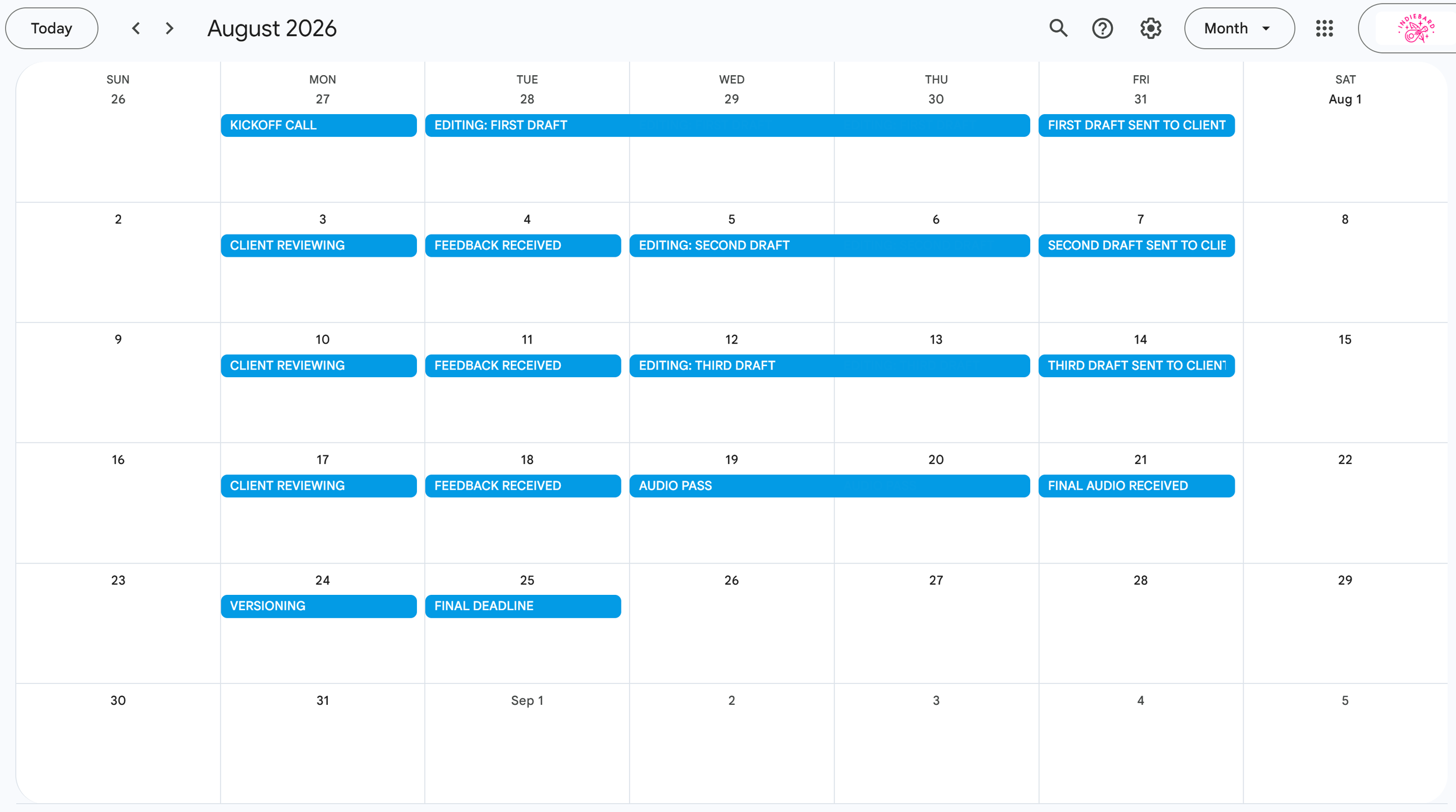
In this case, kickoff means I would have received all brief materials including a capture-ready build of the game, the music chosen for the trailer, any art assets I could use for motion graphics, and all other assets like fonts, logos, etc. Let’s also assume the script is already final.I usually provide three full drafts built into the schedule, and ask clients to send feedback after 2-3 business days.This sample also has 2-3 days built in for the game composer to come in and do an audio pass for a music update and audio balancing.Versioning refers to all the many versions you might need of the trailer, and might include alternate CTA messaging to promote a demo, different logos on the end slate for console platforms, or 9x16 versions for social media.4-week project schedules are probably the most common for editors working on indie game trailers. There’s little room left for delays in this schedule, so while this would not be considered a rush project, it will be important for everyone to work together to keep the timeline on track.Here’s another example, based on a 2-week turnaround with the same deadline.First Draft: August 13thFeedback requested by August 14th
Second Draft: August 18thFeedback requested by August 19th
Third Draft: August 21stFeedback requested by August 24th
Final Deadline: August 25th
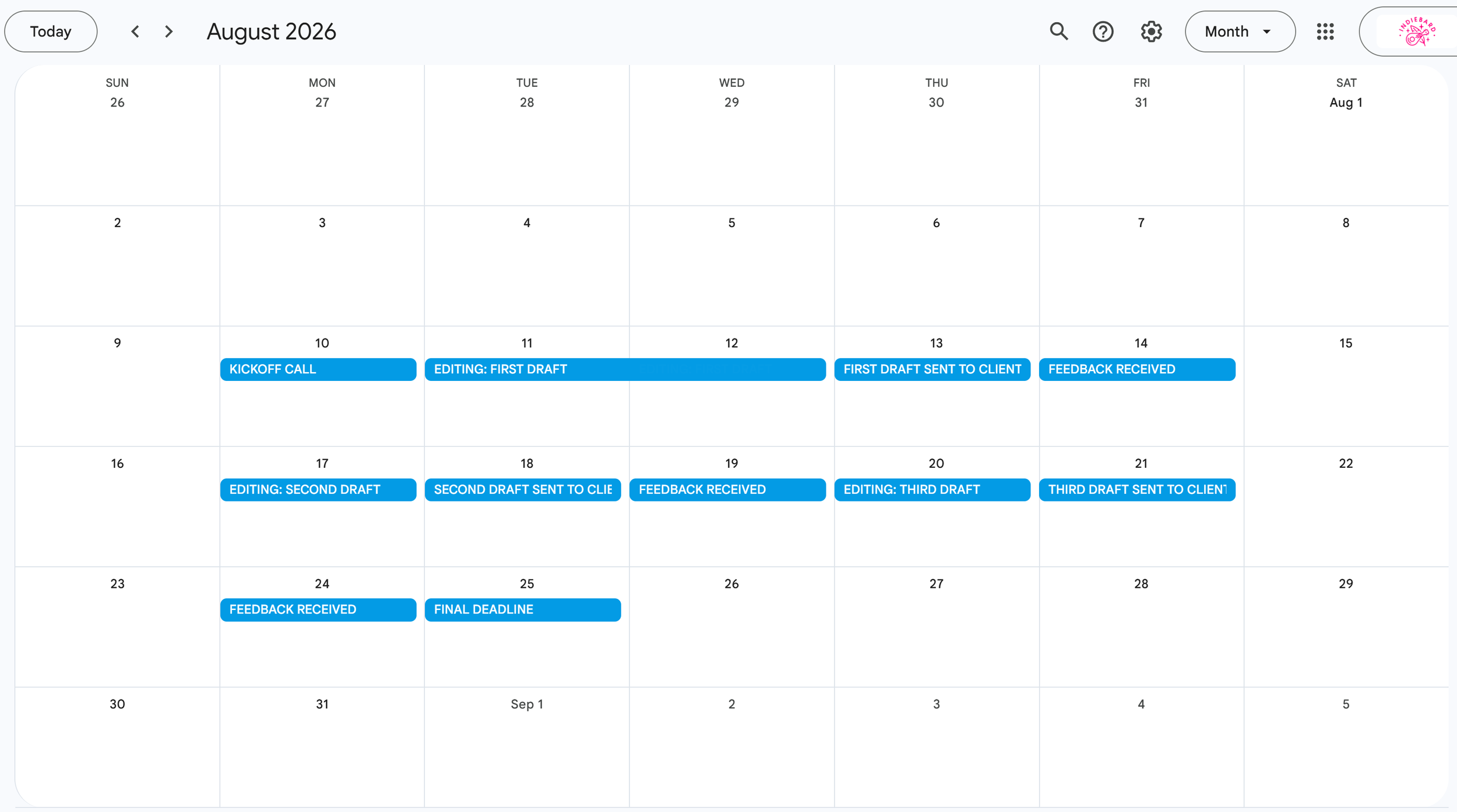
This sample requires the dev team to provide feedback in 1 business day, drafts are turned around in 1-2 business days, and does not include an audio pass. Also, final versions are due the day after the Third Draft’s feedback is received, which means final polish tweaks might not even be seen by the client until they receive the final versions.This schedule is doable, and I’ve done a lot of projects like this! It’s just stressful, and really requires all parties to be extremely committed to staying on task. There’s also very little room for discussion and collaboration; you have to hope that everyone is moderately happy with the direction the trailer is going in, from the get-go.Most editors will charge an additional rush fee on projects like this, to account for both the additional stress it puts on the editor, as well as the need to make this trailer the top priority over any other ongoing projects.FINAL THOUGHTS
Rush projects are going to happen from time to time. With press showcases being what they are currently, it’s not uncommon for a team to get surprised by a great opportunity for exposure.My advice would be: try not to make this the norm! Keep in mind that in those sample schedules above, I didn’t factor in onboarding or possible delays like a CEO going on holiday or a major bug needing to be addressed in the capture build.Best practice would be to begin the search for an editor ~2 months before you think you need the trailer. Why did I say “think”? Because timelines change all the time! Plan ahead for the earliest-possible deadline, and you’ll save yourself a lot of stress.And yes, I cheekily made Gamescom the deadline for both sample schedules because if you need a trailer for Gamescom, you should plan on reaching out to an editor very very soon, if you haven’t already.