
Scripting for Game Trailers Series: Introduction
When I meet with a team to start talking about a trailer for their game, I often begin by asking them what their goals are for the trailer. But that’s a bigger question than you might think.Since I come from a marketing background (over 11 years in-house at publishers across books, TTRPG, and video games industries) I can’t help but use the skills I’ve picked up for trailers as well. So I tend to work backwards from goals: first, figure out what are we trying to achieve… and then try to figure out how to actually achieve it, with what you’ve got.You might be thinking it’s not that deep. After all, I’m talking about video game trailers here, so isn’t the obvious goal to get people to buy the game?Well, yeah. But we want the RIGHT people to buy the game. We don’t want everyone under the sun because, let’s face it, not everyone likes the same stuff. And we want to avoid bad reviews from people who were never going to like the game.So we’re looking for your core audience, AKA the people who will really like this game. That leads to good reviews, which leads to word-of-mouth spreading and more of the core audience finding the game, etc etc.And to achieve this result… okay, hear me out… it’s like fishing. You need to use the right bait to hook the right audience.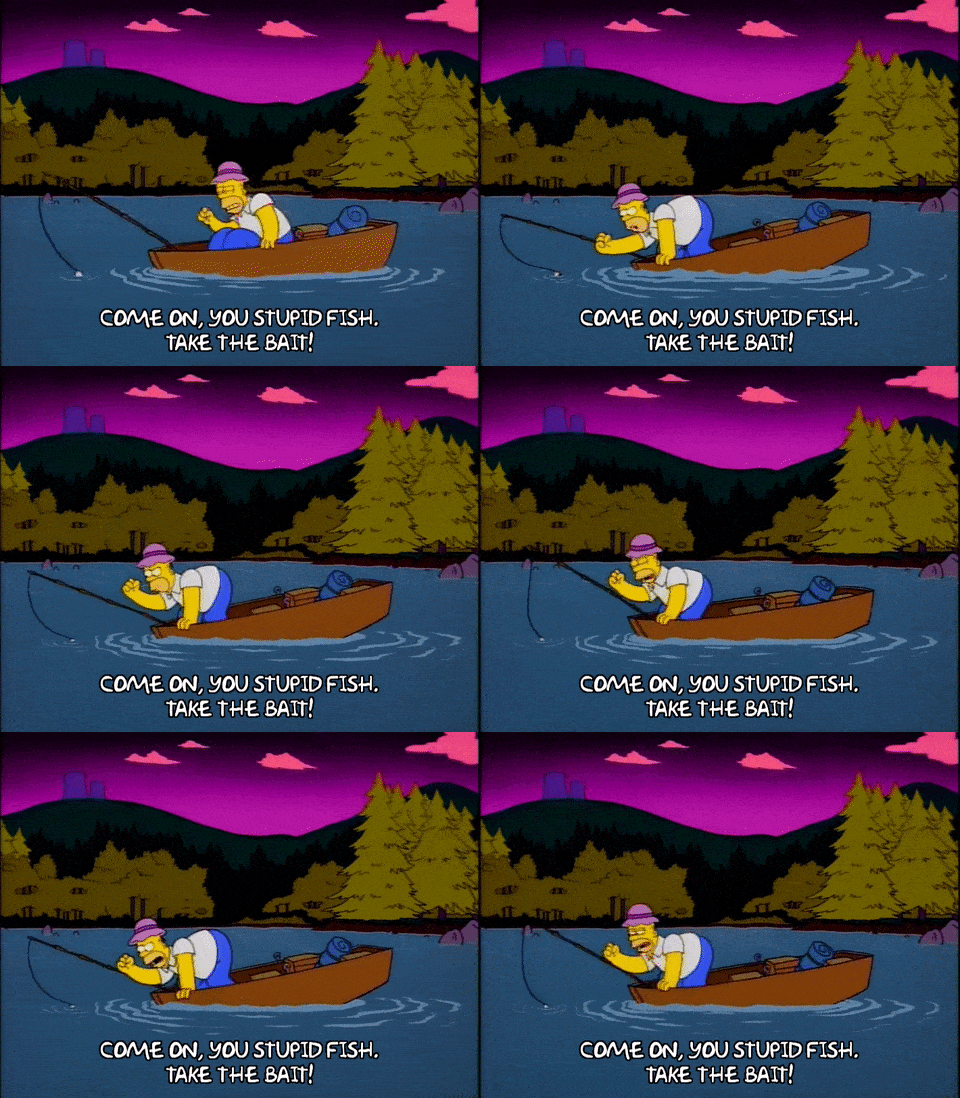
If your audience is fans of cozy games, what does that audience looking for in the games they love? A pretty art style, cute sound effects, low-stakes combat (or no combat at all), and a calm but rewarding gameplay loop, to name a few. And if your game is primarily a cozy game, you want to show off those cozier aspects in the trailer, as some very tasty bait to attract your core audience.Guess what? You just came up with a goal for your trailer! To gain the interest of fans of cozy games.But you might have multiple goals you hope to achieve with a trailer. Here are some quick examples of goals I’ve helped established with dev teams in the past:For a first reveal of a card battler RPG:Establish the game’s place in a combination of genres: collectible card game, roguelike, and RPG.Emphasize game mechanics over narrative elements, since the gameplay experience leans more in that direction.
For the release date reveal of a story-driven spooky game:Tease major elements of the overarching story, to spark intrigue and get people eager to solve the mystery for themselves.Emphasize this as a creepy cozy game, with both quiet and spooky elements.
For a city builder in early access, nearing a 1.0 release:Introduce the game to new viewers, highlighting early access creator builds, and encourage them to try it for themselves.Update existing fans so they know what content is new and why they should return to the game.
Goals need to be carefully tailored to your specific game, as well as where you’re at in your overall marketing campaign.The point is: everything you include in your trailer should be moving you one step closer to that specific goal. The music, the dialogue, the gameplay, the pacing, VFX, SFX—everything should be done with the end goal(s) in mind.And that is your script. The goal is the what, and the script is the how. It’s how you will achieve your goals.When I say the script, I’m referring to everything that makes up details of what we show, when we show it, and how we show it. Scripting doesn’t just mean writing character dialogue. It also has to do with whether we show that character’s face when they first speak, or if we can even clearly hear the dialogue.Take for example this clip from the screenplay for Whiplash, introducing the first scene in the movie: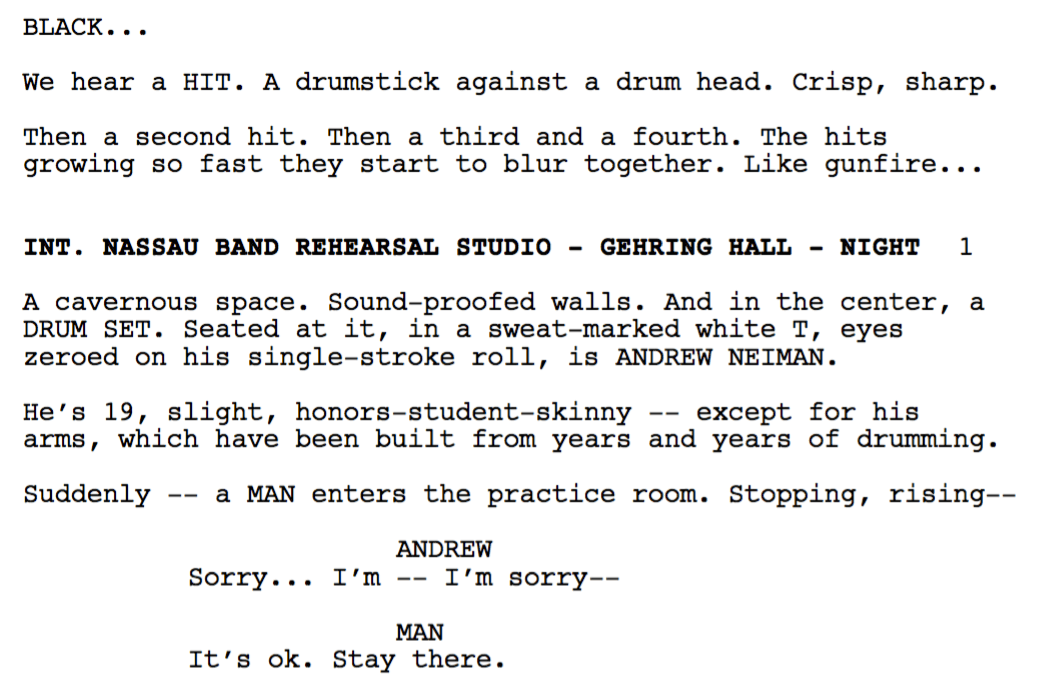
We’re learning a lot from this section of the script. This movie is about a drummer, obviously. The first time we see him, he is isolated in the “cavernous space” he’s first shown in, so maybe this guy is a loner. He’s engrossed in his playing, as he drums intensely “like gunfire” and stops suddenly when the man enters the room, as if surprised by the entrance. This does a lot to introduce our protagonist as a character, a tortured artist figure, with maybe not the best mental stability in relation to his art form.Scripting is deciding what information we will deliver to the audience. Through this information, we can make that audience feel intrigue, fear, sympathy, even hatred. We can encourage viewers to root for a protagonist, to question a villain’s motives, to wonder what will happen next.We can get an audience intrigued in a mystery, excited by gameplay, inspired to create, challenged to win. We can entice the ideal audience, hook their interest, and encourage them to wishlist the game.So let’s talk more about how we do that. Let’s break down scripting into smaller pieces, and think about how we give an audience information that will lead them to our desired goal.PART 1: EMOTIONS
When I write scripts for trailers, I like to do so in table form. Like this:
As you can see, sometimes I like to make a column just to track the emotions we’re aiming to communicate with each individual beat in a trailer. It’s helpful to keep asking yourself as you script out a trailer “does this make me feel the way I want the viewer to feel?”I’ll walk you through a few exercises you can do to determine which emotions are most prevalent in your game. What players will feel when they experience it for themselves. Those are the emotions you should be aiming to make people feel when they view a trailer for the game.PART 2: MUSIC
Music is maybe the single most important element when creating a trailer. In this post I’ll talk about why that is, how I implement music when beginning scripting, and how you can approach a trailer when you just can’t access the music until later in the process.PART 3: TONE
Tone is the vibe check. It’s how we know if we’re having a good time, or a serious time, or a spooky time. I’ll go more into depth to explain how almost every choice you make in a trailer (from writing style to VFX) will be guided by the tone.I’ll be releasing these parts a couple days apart, during this week. This is also by no means every single aspect of scripting for trailers. The key thing to keep in mind is that everything is connected, and because of that it’s important to always keeps your goals in mind as you progress with your scripts.
Stay tuned for more!